top of page

bLOG

Search

Breathing is both affected by and affects the central nervous system.


This means you have the power to observe and adjust how you are feeling simply through observing how you are breathing.


Physicists tell us an observed system is disturbed by the act of observation and call this the "Observer Effect"

And the Sociologists tell us that people behave differently because they know they are being watched, the so called "The Hawthorne effect"


So by you merely observing your breathing, I would place a pretty sure bet, you're going to adjust it slightly!


How you adjust it matters.


A healthy person ought to breath in a pattern where the inhale is shorter than the exhale, there is a slight pause before the next inhale and that in 60 seconds they're getting 5-7 breath cycles. It has been suggested that the "perfect" rate of breathing is 5.5 breaths per minute.


Breath rate aside, as that changes according to activity, the fact that the exhale is longer than the inhale should rarely change. How much longer is completely dependant in activity, but it will nearly always be longer.


Why?


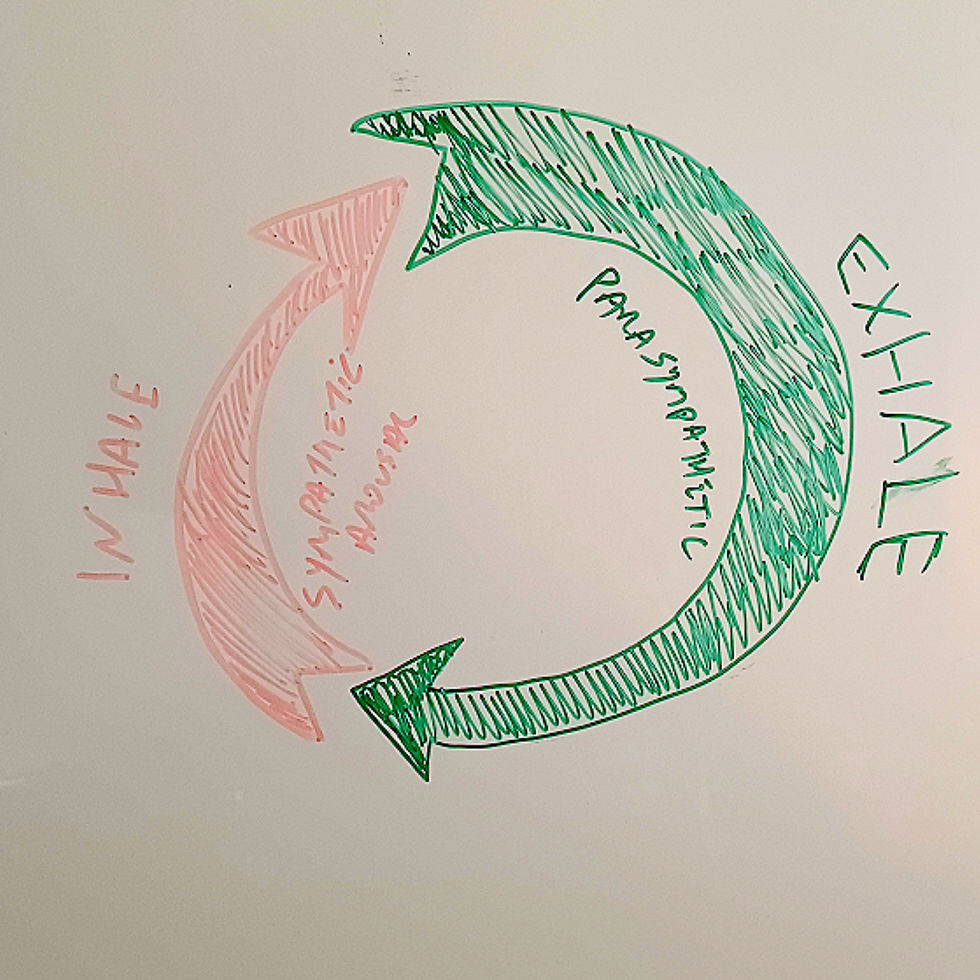
The two images in this post are sketches drawn on my whiteboard in the clinic for a client, so forgive me for not having "professional looking" graphics.


This first image represents the basic breath cycle:

ree

The red is the inhale, notice it is shorter than the green exhale. The red line correlates to the Sympathetic side of the nervous system, the Green, the Parasympathetic side.


Sympathetic: Fight/Flight, Action/Reaction, heightened arousal

Parasympathetic: Rest/Digest, Healing, Recovery, lower arousal


Both sides are necessary, and we can emphasise one or the other through changing our breath.


Deliberately inhaling with more emphasis than our exhale can wake us up, it can ramp us up. You'll notice when someone gets scared, anxious or angry, their breathing speeds up, their inhale is more noticeable than their exhale. If you replicate this breathing pattern now, you will probably notice yourself getting a little angsty, ready to pounce. Try it.

Now, reverse things. Think of someone who's laid back, chilled out. Maybe someone (healthy) who's fallen asleep. Do you notice the depth with which they breath, the longer exhales, the smoother rhythm. Try this yourself, count how long your in breath is, now count the outbreath and make it longer than the in. Do you feel tension dissipating, the body relaxing, maybe the mind slowing?


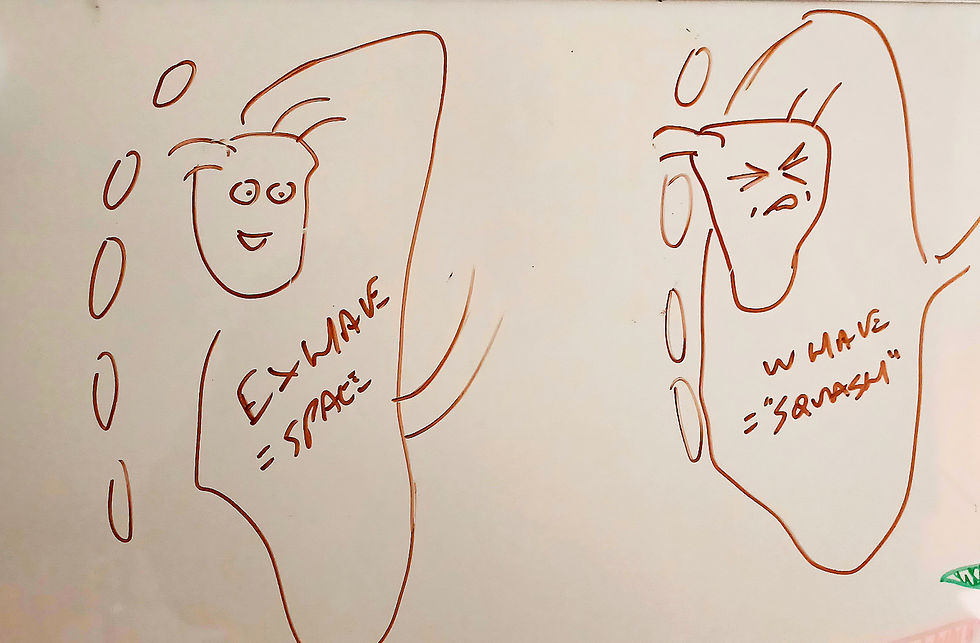
There are several reasons for this, but one in particular I learned quite recently and drew as this image:

ree

This is your heart and a lung inside the ribcage. On the left the heart has room as the lung is deflating with an exhale. This means the heart has room to fill up with it's full load of blood and pump it out to it's, well, to it's hearts content! The neurons in the heart send out signals to down regulate the arousal level, reduce sympathetic tone and allow the parasympathetic do it's job. On the right, the space is getting a little tight as the lung is inflating, meaning less room for the heart. There's a slightly less room, less blood volume and the neurons send out a signal to upregulate the arousal level, the ramp up the sympathetic nervous system.


Now, my sketch is more comic book than accurate. But never the less, this is a genuine response. So now we can see how inhale dominant breathing is going to send out more stress signals and the exhale dominant breathing will send out more relax signals.


How we utilise this is up to the individual.

If we feel stress, we can deliberately slow our breathing to mitigate it. If we're feeling tight and anxious, we can observe our breath and make appropriate changes. If we're exercising, this is one mechanism we can use to prevent us losing focus due to hyper arousal, we can slow fatigue and moderate ourselves somewhat.


If we're working our rehab and injury management drills, then we can ensure we're in the rest/digest world where the body is much more likely to respond in the manner we want it to.


So I ask you, how are you breathing right now?


Which is longer, the inhale or the exhale?


Regards


Dave Hedges www.DaveHedges.net


You may hurt

You may have an injury

You may have been told something scary by a doctor


But you aren't written off yet.


If you're still breathing, you are alive.

If you are alive you can take control


If you take control you can make improvement.


1% improvement, each and every day.


We never know how far you can go in your recovery, but every person I've worked with who has committed themselves to the process makes progress. It may be painfully slow, but it's progress.


Forward movement is forward movement.


You are not broken. Bones heal, muscles repair themselves, scars fade. Your nervous system, your brain remembers. So by taking control, you show your brain who's boss, you say to it, I am not broken, I will improve.


1% today

1% tomorrow

1% the day after that


Take charge.


Regards


Dave Hedges


The Clavicle, or Collar Bone is a relatively thin shaft of Bone that runs from the top of the sternum put to the shoulder.

It partners with the scapula and the humerus to create the shoulder complex.


This is Bone that maybe doesn't get the attention that it deserves, until of course, you injure it.

The three biggies are:

Broken Collar Bone

Damaged AC (Acromioclavicular) joint

Damaged SC (Sternoclavicular) joint.


My sketch here shows the Right Clavicle, as it would look facing a person.

Top image is the front, then it "rolls down" to show the rear.

The Good stuff is mostly in the rear of this Bone as it sits so close to the skin.


ree

The really fascinating part about this Bone is that the sternal end, the part that sits on the sternum is the only bone/ligament attachment point for the shoulder complex onto the axial skeleton.

All other attachments are muscular/tendinous.


That said, here are the muscles of the Clavicle:


  • Deltoid - Anterior deltoid runs from the Clavicle to the humerus

  • Trapezius - the upper Traps have fibres attaching to the posterior side of the Clavicle.

  • Subclavius - runs under the Clavicle, between it and the ribs attaching to the cartilage of the first rib.

  • Pectoralis - the upper pec attaches to the Clavicle and likely helps elevate the arm into flexion, or as I prefer to think, decelerate the arm as it goes into extension

  • Sternocleidomastoid comes from the manubrium (top section of the sternum) and the Clavicle running diagonally up to the temporal Bone at the base of the skull behind the ear.

  • Sternohyoid is a wee muscle that moves the hyoid bone that sits above the larynx.


In terms of movement, the Clavicle moves in a kind of synchronicity with the scapula.

The Sternoclavicular Joint is a saddle joint, of which there are only a handful in the entire body.

These being our thumb, the joint between the calcaneus and cuboid (in the foot) and our inner ear.


The Clavicle "rides" atop the sternum akin a rider atop a horse.

It's motion is almost like the Angled Barbell or Landmine set up, a near universal joint at the anchored end allowing relatively free movement at the other end.


At the other end we find the AC joint, the Acromioclavicular joint.

This is where the Clavicle meets the Acromium of the scapula. The acromium is that finger like protrusion that come off the top corner of the scapula wrapping around over the humerus to meet the Clavicle.

This joint can be quite vulnerable to injury with AC joint injuries being quite a common impact injury.


A fall or heavy impact to the shoulder or outstretched arm may push the acromium downward faster than or further than the clavicle can keep up resulting in damage to the ligaments there.

We may possibly be able to mitigate this risk by ensuring the clavicle and scapula both have adequate strength and mobility, while ensuring the rhythm between the two bones is on point.


It is my opinion that the "shoulders back and down" cue, and the move away from overhead lifting are both deleterious to the health of the shoulder as they discourage good movement and rhythm between the clavicle and scapula.


Adding in good old fashioned joint rotations, shoulder circles, arm circles etc. The various Cog movements I advocate, and "free scapular" upper body lifts, including overhead work, in the gym should keep things in check.


The Clavicle is an interesting and underappreciated bone, it's not as sexy as its flashy brother, the scapula

Underappreciated that is until it's broken. Or you damage the AC joint, or, like me, you dislocate the SC joint


Regards

Dave Hedges


bottom of page
Trustpilot